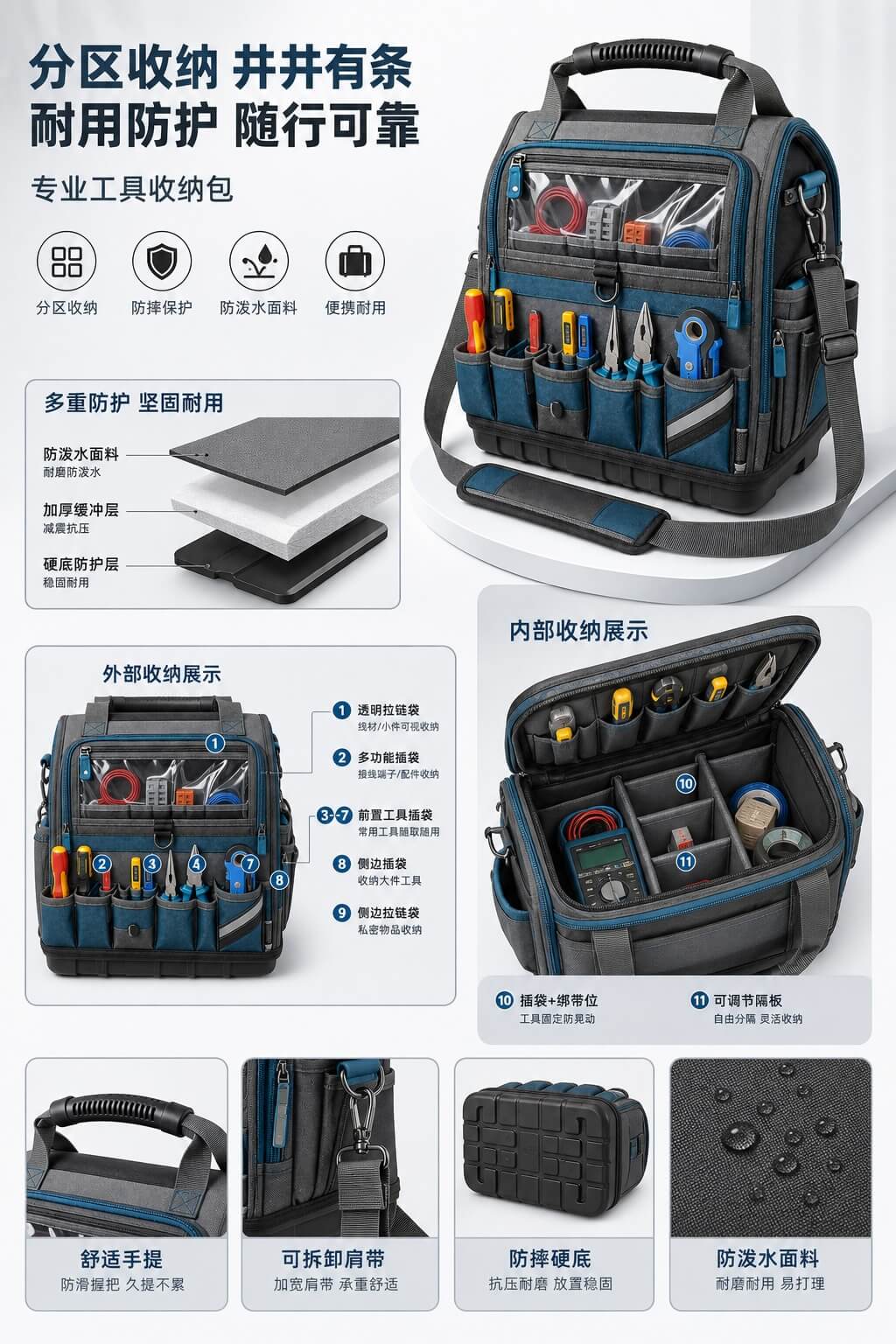
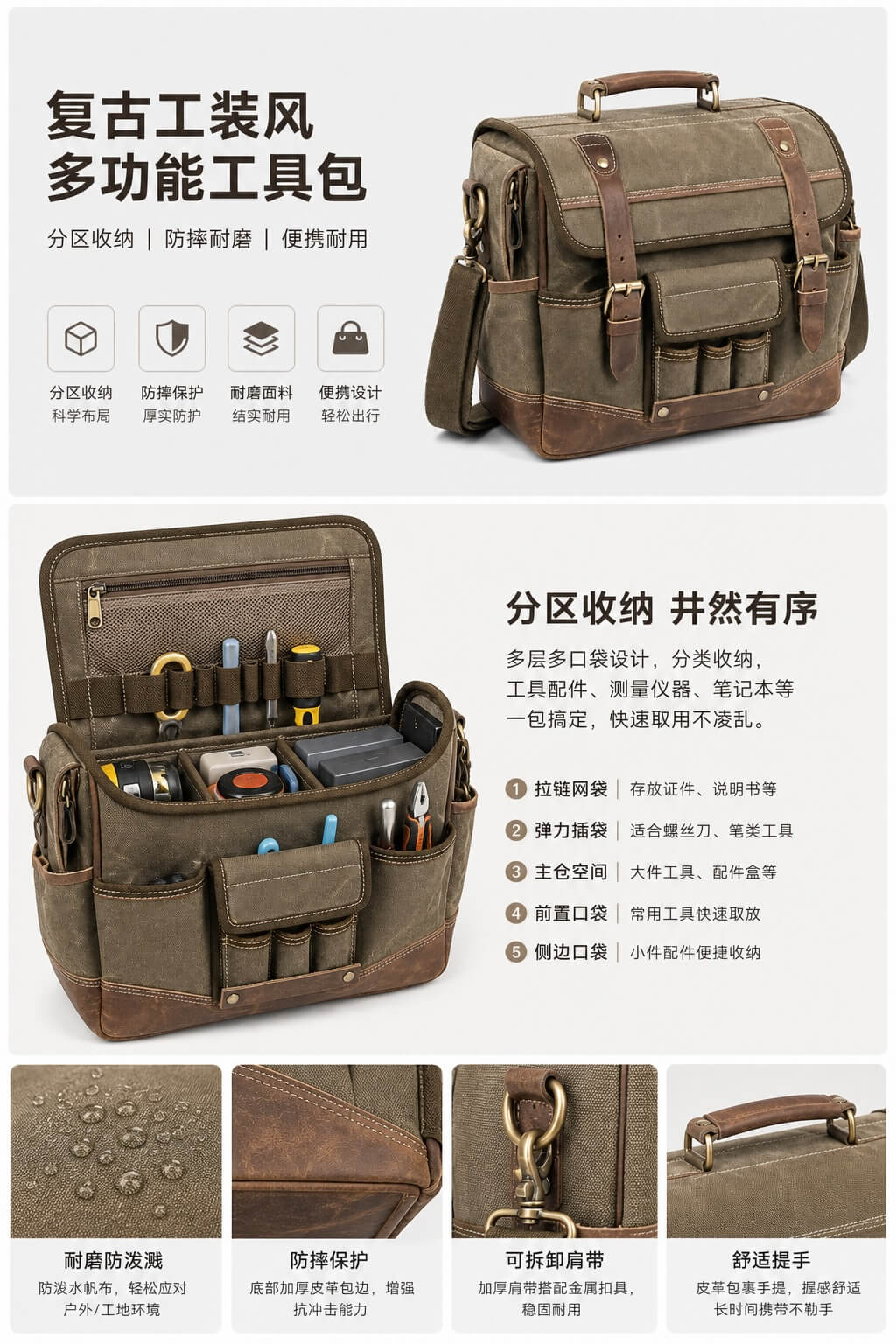
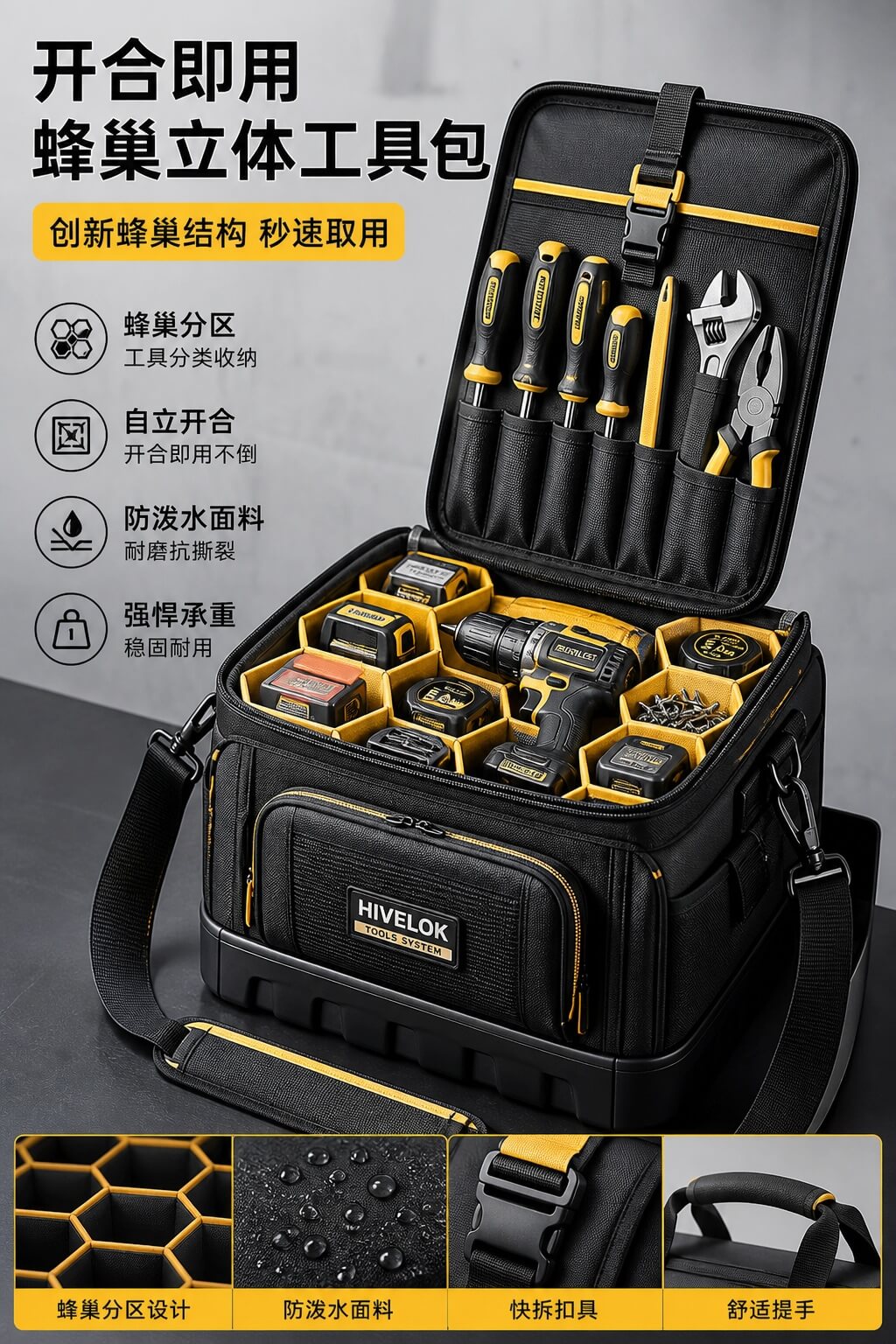
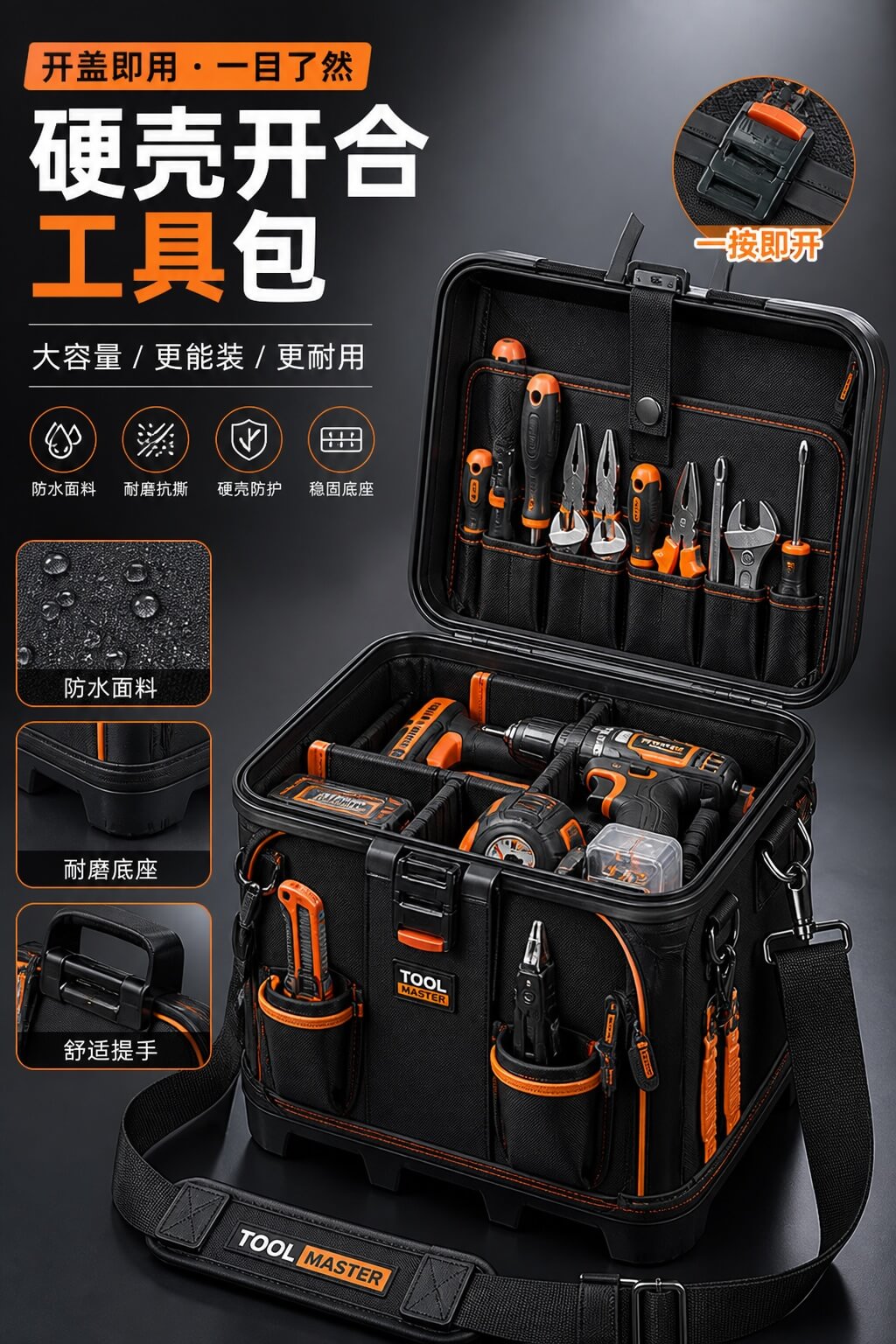
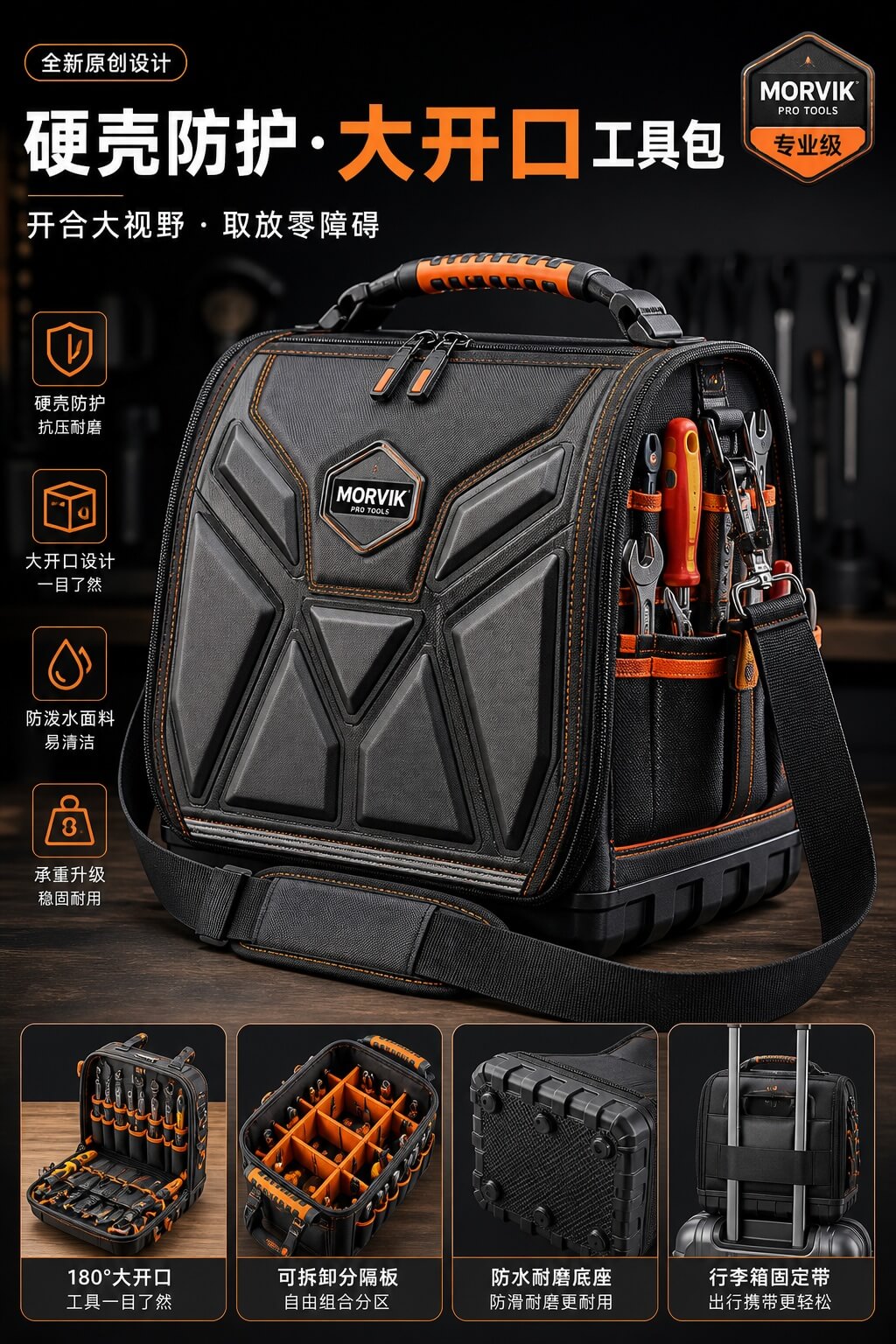
Tool Bag design renders
Tool bags are a steady volume category with Western sourcing buyers: they look at how the compartments work, whether the fabric survives a job site, and how the mouth frame and base are reinforced. When a buyer says “something tougher for electricians”, type that in, pick a few options, and ICRE.AI returns 4 different original proposals — heavy-duty American to urban minimal — to send back.
What we handle for this category
Designed around the job
An electrician, a mechanic, a carpenter and a rope-access tech need different compartments and attachments — the renders spell out the layout for the scenario you pick.
Durability you can see
1680D oxford, heavy canvas, waterproof TPU coating, leather-reinforced base, metal mouth frame, rubber feet — the details a sourcing manager actually inspects.
Genuinely different forms
Hard case, tool roll, open-mouth tote, backpack, belt pouch, fold-out work bag — the four in a run will not all be the same shape.
Ready for private label
Upload the buyer's logo or type their brand name, and the mockups come back as their private-label product.
Real generated samples
All 4 images below were generated by ICRE.AI with no retouching — original proposals, ready to guide sampling and tooling.


What you can change
These attributes get combined into different design directions, and no two proposals in a run land on the same combination. You only tap options — the vocabulary is ours to worry about.
- Form
- Hard case / tool roll / open-mouth tote / tool backpack / belt pouch / zip carry bag / fold-out work bag / drawer-style soft case
- Fabric & finish
- 1680D oxford / heavy canvas / waterproof TPU / reflective trim / leather-reinforced base / MOLLE webbing / rubber non-slip base / flame-retardant fabric
- Structural features
- See-through tool loops / metal mouth frame / removable divider board / external clips / trolley sleeve / magnetic panel / padded shoulder strap
- Graphic language
- Solid / embossed geometry / color-block / graffiti / embroidered patch / all-over print / mixed-material panels
- Use case
- Electrician / auto repair / carpentry / rope access / in-vehicle / trade-show display
- Style
- Heavy-duty American / retro canvas / hi-vis safety / urban minimal / outdoor techwear
When it earns its keep
Pitching a sourcing buyer
All you get is “something tougher for electricians” — type exactly that in, and in minutes you have 4 proposals to show instead of questions to ask back.
Filling out a product line
Take one fabric and finish into a tote, a pouch and a backpack, and your quote sheet suddenly has a full line.
New listings
Turn the proposal the buyer picks into a detail-page layout and multiple angles — the listing assets come from the same run.
FAQ
- How many proposals per run, and will they look alike?
- Four proposals per run, ready in minutes. They are not four rolls of the same dice: the system first draws mutually different combinations across axes like silhouette, material, graphic language and carry style, then has the model turn each combination into a coherent design spec. The four also target four market positions — safe mainstream, current trend, differentiated, and exploratory.
- Can the generated tool bag renders go straight into tooling?
- They are concept renders, not engineering drawings. In practice the buyer picks one of the proposals, then you hand it to your structural or pattern maker for dimensions. The renders are written to be manufacturable — capacity, compartments, hardware and finishes all read the way a sample maker expects.
- Will it copy someone else's brand or character?
- Every prompt carries the category's IP constraint: no copyrighted or trademarked characters and logos, no 1:1 copies of a specific competitor product, all graphics original. Tool bags is a category where licensed IP is everywhere, so "make the original equivalent instead" is written into the constraint. Still run your own clearance check for the market you sell into.
- Can I put my own logo and brand name on it?
- Yes. Upload a logo image and it gets printed on the product in a visible spot, matched to the material; or just type the text you want printed (a brand name or tagline). Mockups that already carry the buyer's brand close very differently.
- Can I specify fabric weight, dimensions and so on?
- Write a plain-language note such as “must fit an 18V drill, reinforced base, trolley sleeve”. Only the parts about structure, compartments, material, finish, color and use are taken up; exact dimensions and fabric weights belong to the pattern stage, not to a render.
- My factory makes something else — can I still use it?
- Yes. A category here is just configuration (category brief, attribute axes, shot spec); once it is set up, the same flow works. Email what you make to hi@icre.ai and we will configure it for you.
Related guides
One question per guide, a few minutes each.
- Can the generated bag renders go straight into tooling?A render is not an engineering drawing. What a render does commit to, what your sample maker still has to add, and the steps between receiving the images and cutting a sample. Tool bags as the example.
- A factory with no designer: what do you do when a buyer wants new designs?A small factory has three ways to get a new design: copy what is on the market, hire an outside designer, or employ one. What each costs, which step AI renders can take over and which they cannot, and how to try it the first time.
- The buyer wants their own brand on it. How do you get a logo onto the renders?Upload the buyer's logo, select it under "print your brand" when you render, and all four designs come out with it on the front. A line of text works too. A buyer looking at their own brand on the product says yes far more readily than one looking at a blank render.
A buyer waiting on new Tool Bag designs?
Sign in, type the buyer's request, pick a few options, and get 4 proposals in minutes.
Sign up / Sign in to start